
Things to see and do in Cooktown

There is so much to see and do in Cooktown! 
A wonderful untouched paradise where you can immerse yourself in this small historic coastal town surrounded by stunning countryside.  Fish with the locals down at Fisherman's wharf, once one of the busiest ports in Queensland during the Gold rush. Catch Spanish Mackerel, Barramundi, Queenfish and more, or go with a local expert. Tinnies for hire can be found at the wharf.  Make the climb up Grassy Hill for spectacular views especially for the sunsets and sunrises. 

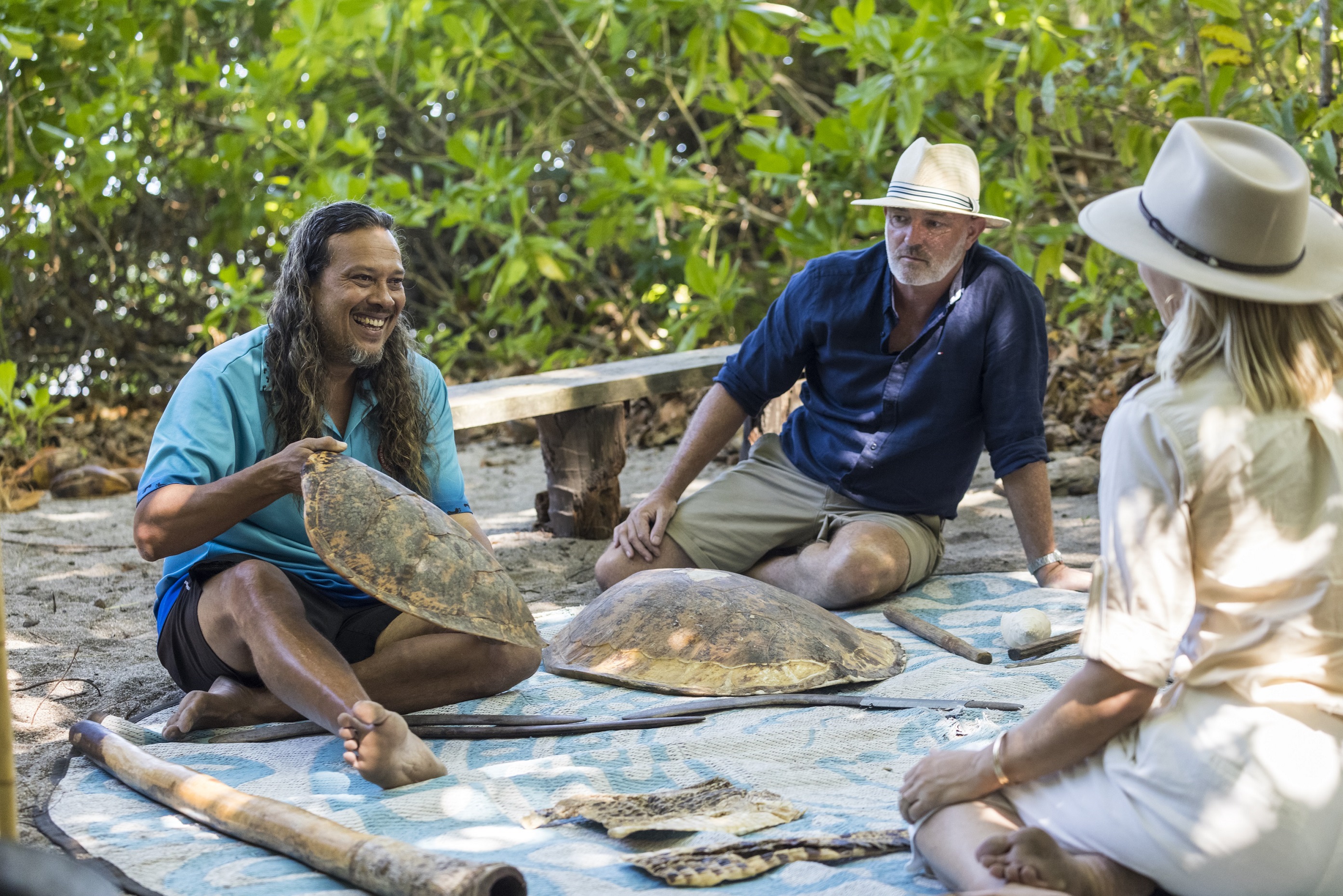
Walk with the traditional custodian Wilfred (Willie) Gordon of Guurrbi Tours. On this magical Cooktown tour Willie takes guests to his ancestral rock art sites, set in stunning countryside high in the hills outside Cooktown.  The sites are not open to the general public and cannot be visited unaccompanied.  Willie's Rainbow Serpent Tour is now listed as One of Australia's Ultimate Must-Do Experiences, both by American Express (2006) and Australian Traveller magazine (2007).


The James Cook Museum

Recently renovated, this museum is operated by the Queensland National Trust and is regarded as the best regional museum outside any capital city in Australia. The building was erected as the convent of Saint Mary and was built during the gold rush era in 1888-9. This was the first high school in North Queensland.

During World War II, the building was used as a U.S. command post and the Sisters of Mercy were evacuated, never to return. The building fell into disrepair until 1969 when it was restored to its former glory and was reopened by the Queen in 1970 as the "James Cook Museum". It was again refurbished in 1999 and now houses the anchor and cannon of the HMS Bark Endeavour and Chinese, Pastoral, Mining, and Indigenous collections.

The museum is a large, two storey building located on Helen Street between Furneaux and Walker Streets and should not be mistaken for the Cooktown museum (privately owned) on the corner of Walker and Helen Streets. James Cook museum is open daily from 9:30 am to 4:00 pm.


^ Back to top


Cooktown Visitor e-Guide Booklet -Click on the guide book below for the 2009-10 e brochure


Nature Powerhouse Museum

Cooktown's accredited Visitor Information Centre helps to give visitors and understanding of Cooktown and Cape York Peninsula's unique and fascinating flora and fauna. It is located within 154 acres reserve of native and exotic plants.

Nature's Powerhouse is home to a priceless collection of botanical illustrations of flowering plants of the Endeavour River. Painted by Internationally recognised artist Vera Scarth-Johnson, they were donated to the people of Cooktown before her death in 1999.

The Powerhouse is also home to a remarkable exhibition of local wildlife bequeathed to Cooktown by Charlie Tanner, who dedicated his life to recording information about the reptiles and bio-diversity of Cape York Peninsula.

The Verandah Cafe makes a delightful rest stop with an opportunity to browse through Nature Lover's bookstore, local artworks and souvenirs. The Cafe is open 10am to 4 pm.

^ Back to top

Cooktown Cemetery

The Cooktown cemetery is easily accessible on the southwestern edge of town, along the McIvor Road. Within it, diverse historical, social, architectural, artistic, religious and cultural practices are reflected. Graveyards are not simply memorials to the dead but act as testimonies to their rich, varied and colourful lives.

The oldest identifiable grave is that of Rev Francis Tripp, who died on 20 May 1874 at the age of 46 years. The cemetery at Cooktown is the final resting place for many of the diverse nationalities, religions and cultures that inhabited the pioneering town. The story that unfolds bears witness to the tragedies, triumphs and mysteries experienced by the people in times of exploration and adventure. Many of the events and individuals that contributed to Cooktown's development are recorded here.

^ Back to top

Mrs Watson's Memorial

Mrs. Watson's Monument is dedicated to Mrs. Watson, who survived an aboriginal attack on Lizard Island, to die later on Number 5 Island of the Howick Group.

The wife of a beche-de-mer fisherman, Captain R.F. Watson, she remained on their fishing station with her infant son and two Chinese servants while he was away fishing. In September 1881 they were attacked by Aboriginals. One of the servants was speared, but Mrs. Watson and her infant son and remaining Chinese servant escaped in a boiling down tank to Number 5 Island. Due to dehydration, as there was no fresh water, they finally perished. Their remains, together with her diary, were found in 1882.

In commemoration of this event, this monument was erected and at one time was used as a water fountain for the people of Cooktown, so that everyone could re-hydrate themselves.

^ Back to top

The Milibi Wall (The Story Wall)

Designed and constructed by local Aboriginals, as part of a Gungarde project, the Milibi wall is a beautiful collage of Aboriginal art. The story wall is composed of three separate sections, each of which is curved. The Milibi wall is to the left of the first turn off to the wharf, so park your car and have a look. The Milibi Wall is definitely worth looking at and makes up a part of the local culture of Cooktown.

^ Back to top

Grassy Hill Monuments

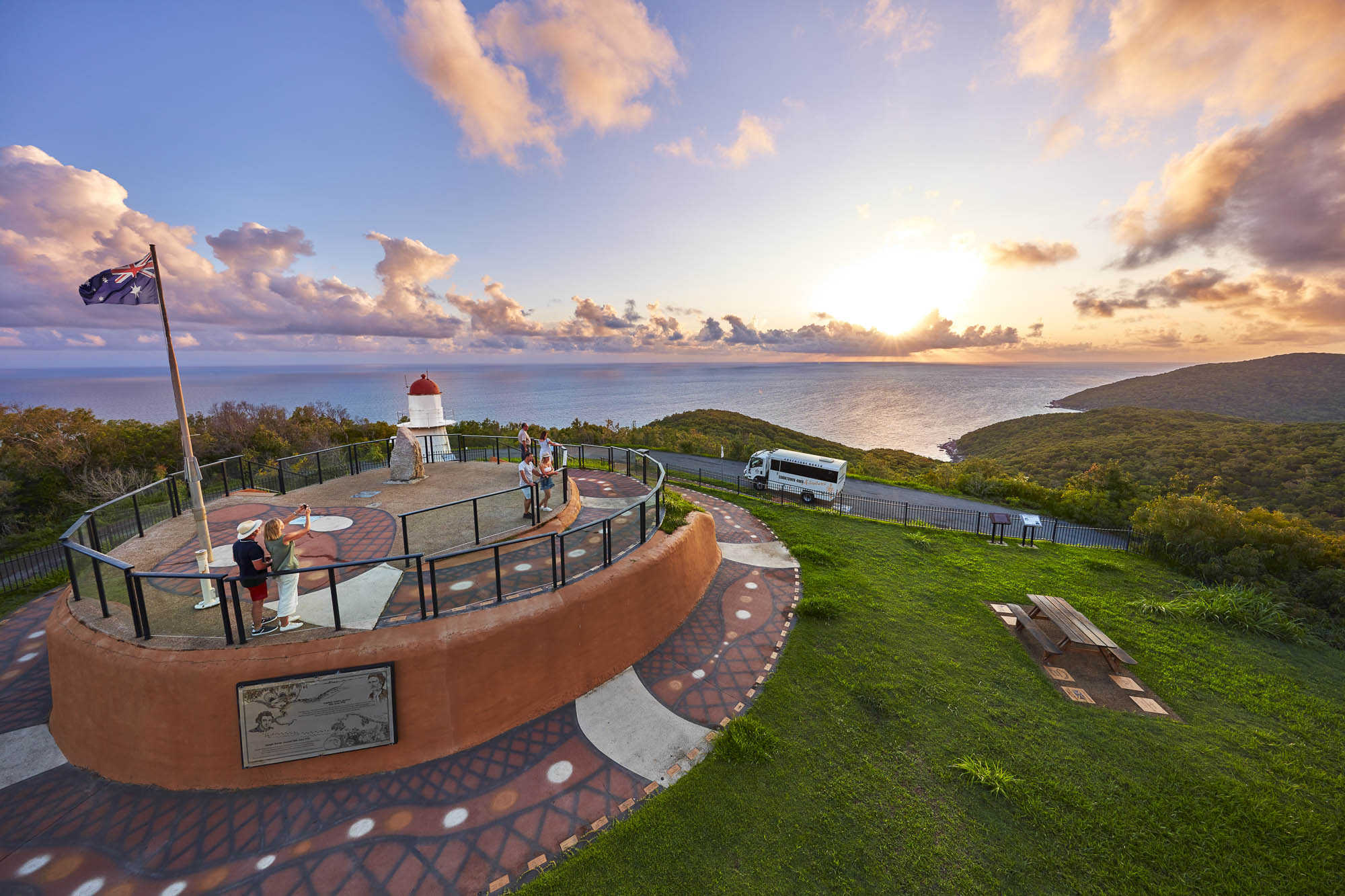
Located at the eastern end of Hope Street, Grassy Hill is known as such because the aboriginals burnt the forest on the hill to encourage re growth of vegetation and to draw animals back to the region. Due to this, the hill was covered only in grass when Captain James Cook arrived in 1770. Captain Cook climbed the hill on several occasions to view the surrounding reefs, enabling him to navigate a safe passage out after repairing his ship.

Grassy Hill Lighthouse
Trees now cover the hill, along with the occasional house and the hill is also home to the Cooktown lighthouse and sun dial. The lighthouse was built in England and shipped to Cooktown in 1885. It was automated in 1927. Between 1942 and 1945 it was complemented by a radar station and was subsequently dismantled after World War II. It served the local community and shipping in the area for 100 years until it was made obsolete, and then restored by the Lions Club.
Try to visit the lookout to catch a sunset. Getting there is easy - just drive or walk straight up the hill from Hope Street. If you decide to walk rather than drive, bring some water!


Grassy Hill Sun-Dial
Although it gives the appearance of a sun dial, this lovely monument is a "Global Positioning Monument" and actually shows the distances to different cities and the directions in which they lay. Some of the cities include New York, London, and Tokyo. Imagine how far you are away from home!

Captain Cook's Grassy Hill Monument
Captain Cook's Grassy Hill Monument  This monument commemorates Captain Cook's landing and trips up Grassy Hill in 1770. In addition, there is a large board, to the side of the peak of the hill, that details of Cook's trip and his journals. Imagine yourself here over two centuries ago, looking out over the town, with Grassy Hill's 360 degree view. Imagine seeing everything for the first time and then explore the rest of Cooktown. Enjoy your stay in paradise.

^ Back to top

Fishing and Boat Hire

One of Cooktown’s simple pleasures can be found fishing with the locals at the Wharf.
One of the unique features of fishing in Cooktown is that large Spanish Mackerel, Barramundi, Queenfish, Trevally and Mangrove jack can be caught just by walking onto the public wharf and throwing in a line. 

Boats for hire can be found at the Wharf, together with marine fuel supplies, bait and ice.

Take advantage of the local knowledge and experience of Reef or River fishing tours.


^ Back to top

Cooktown Sightseeing Tours

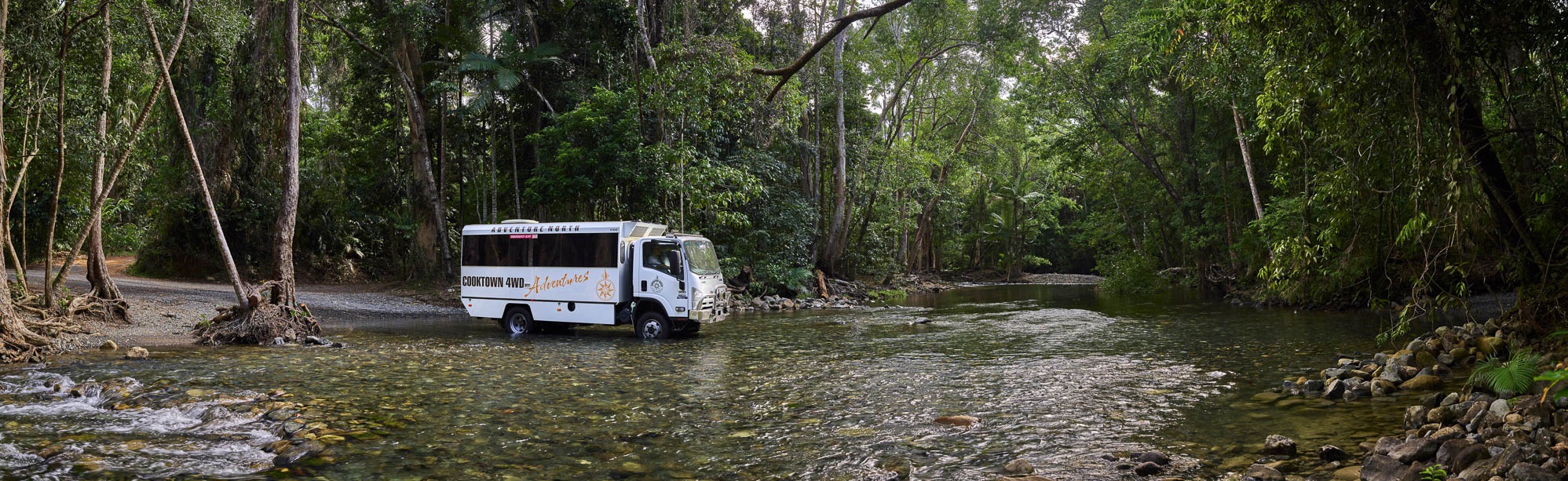
Choose one of the many guided tours available in comfortable air-conditioned buses and four wheel drive vehicles.  

Secluded Beaches-Walking Trails

A short drive, or a lovely bush walk through the Botanic Gardens takes you to Finch Bay . This spectacular beach, surrounded by mountains, is the perfect spot for a picnic, fishing or just sunbaking. Cherry Tree Bay is a beautiful secluded beach, where on occasions turtles and dugongs can be sighted.  The beach is accessible by either a 2500m track from the Botanic Gardens, or a track which starts from halfway up Grassy Hill.  Both tracks require reasonable fitness level.


Guurrbi Tours
Aboriginal Rock Art Tour

Located outside Hope Vale Aboriginal Community, and thirty minutes drive from the small and friendly historical township of Cooktown, the Nugal-warra rock art sites are set in a dramatic landscape with stunning views. They reflect the Laura rock art style, while depicting the historical events, myths and legends particular to the Nugal-warra people, members of the Guugu Yimithirr tribe whose nation extends from the Annan River to the Jeanie River north of Starcke.
Guurrbi Tours offers a rare opportunity to walk with
Willie Gordon , a Nugal-warra Elder, on his traditional lands, and to see the rock art through his eyes, and to learn why the paintings’ conservation is of such importance to the Nugal-warra people.
Previously inaccessible to visitors, the multitude of
rock art sites are steeped in stories of both cultural and spiritual significance, and include the Reconciliation Cave, which portrays a heart-warming story of acceptance and compassion, and an ancestral Birthing Cave which is a place of particular importance to the clan.


RAINBOW SERPENT TOUR

ADULT

$120

CHILD 3-13

$75

Departs Cooktown Mon-Sat 7.45am

This walking tour will take you through a dramatic landscape to six rock art sites, including an ancestral Birth Cave, a place of particular importance to the clan, and the Reconciliation Cave which portrays a heart-warming story of acceptance and compassion. You will hear the stories behind the paintings and learn why this art is so important to present and future generations of Nugal-warra people.
Includes an estimated 30-minute bush walk on generally easy terrain. Covered shoes must be worn.Water provided.

GREAT EMU TOUR

ADULT

$95

CHILD 3-14

$60

Departs Cooktown Mon-Sat 1.15pm

This tour includes a visit to three rock art sites, including the Great Emu Cave, and provides a fascinating introduction to Aboriginal culture and society, and to the traditional survival techniques of the Nugal-warra people. 
Suitable for MOST ages; very little walking involved. Covered shoes must be worn. Water provided.

^ Back to top